

I have spent years helping travel businesses fix their websites and win customers online. One pattern shows up again and again in the Gulf. A small agent in Dubai or Jeddah feels crushed by the giants.
Booking.com, Expedia, Wego, and Almosafer sit at the top of every search. They spend millions on ads. They run huge tech teams. A two-person agency cannot match that budget. For years, that appeared like the end of the story.
It is not anymore. AI has changed the rules. Small agents now win by out-serving the big sites, not out-spending them.
The market is huge, and still up for grabs
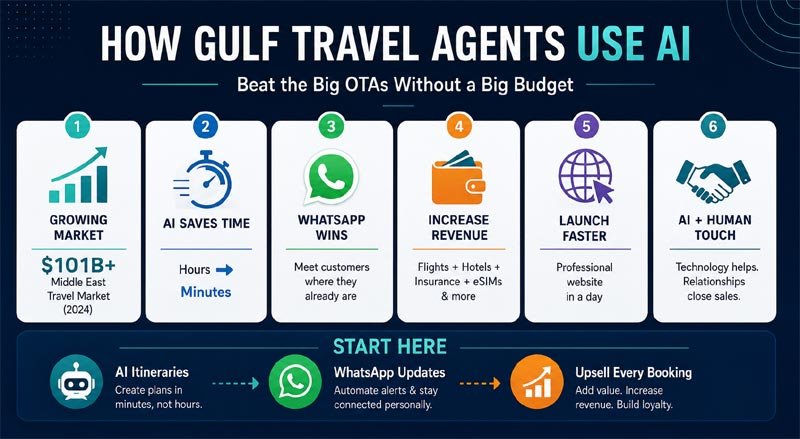
The numbers explain the fight. The Middle East travel market booked $101.2 billion in 2024, according to Phocuswright. That figure was 23% above pre-COVID levels. Online booking is climbing fast too. Phocuswright expects online share to rise from 48% in 2024 to nearly 60% by 2028.
More travelers go digital every month. The big booking sites get most of that traffic. But by most, we do not want to say all, there is always room for someone to grab a slice. An intelligent local agent can grab a real slice.
Here is the good news. Gulf travelers want a human touch. They want someone who knows a family of six needs a hotel near the Haram. Everyone doesn’t only want to go for the cheapest room. AI helps a small agent give that special care at speed and at least additional prices.
Trip planning that took hours now takes minutes
Start with the boring work. Building an itinerary once took half a day. You were required to check flights, hotels, visa rules, and prayer-friendly stops one by one.
AI tools have changed all of this. An agent enters a client’s requirements into a chat tool and gets a draft plan in seconds. You can, however, add your own judgment on top of what it created and personalize. The AI does the hard work, though.
The agents have to treat AI like a sharp intern. It drafts fast. However, nothing goes out without your approval. That is the balance that keeps quality high while keeping the client happy.
The agents I discussed this report the same thing. Quotes that took an evening now go out in minutes. Faster replies more often win bookings; it is as simple as that. The client who hears back first often books first.
Want proof of the demand? Look at how travelers research before they even call you. Guides like this list of the best flight booking websites in the Middle East show how much homework people do first. Your job is to beat that research with something more personal.
WhatsApp serves as your secret weapon
Now for the part the giants struggle to copy. In the Gulf, WhatsApp is not a side channel. It is the main street.
Around 80% of people in the UAE use WhatsApp, per We Are Social data. Research from Northwestern University in Qatar found that 75% of nationals across seven Arab countries use it too. Your clients live inside that green app all day.
Big booking sites push you into their own apps and stiff emails. A small agent just messages the client where they already sit. That feels warm and personal. That feels local and creates trust.
AI copilot tools now handle this for you. They send the ticket, flight alerts, and check-in reminders straight to a client’s chat, all under your brand. A platform like Flyo.ai does exactly this, and says more than 2,000 agents already use it. The idea is simple. You keep the personal feel while software carries the heavy load.
Turn one ticket into real profit
Selling a flight alone is not a very profitable business. The commission barely covers the cost leave aside profits. The big sites know this. They upsell hard at checkout.
You can check out any booking flow online. It offers seats, bags, insurance, and lounge access before you pay. Each add-on adds to their margin. Small agents earlier used to miss all of that money, but not anymore.
AI shifts things here. The same copilot tools let you offer lounges, eSIMs, meals, and travel insurance beside every ticket. The client taps “add” inside WhatsApp. You earn the commission. No sales pitch required, just pure magic of technology.
Think about a Riyadh agent booking an Umrah group. Sell twenty eSIMs and twenty lounge passes on top of the flights. That adds up to total billing and, in turn, profits. One booking becomes many minor gains. Do that in a busy season, and the agent’s extra income can outperform the ticket sale income.
A real website, live in a day
Trust starts with looking legit. A shady-looking page scares Gulf clients away, and rightly so.
Old website builds cost thousands and dragged on for months. Many small agents just skipped it. That left them invisible online while the giants soaked up every click.
AI site builders have knocked that wall down. An agent can launch a clean, branded site in about a day, with no coding. It can handle several languages too, which matters in a region where Dubai alone hosts dozens of tongues.
Is it as slick as Booking.com? No. Be honest about that. But it does not need to be. It needs to look trustworthy and load fast on a phone. That bar is very reachable now.
The catch worth knowing
AI is no magic wand. It makes mistakes. It might suggest a closed hotel or a wrong visa rule. You must check its work every time before sharing it with the client.
Clients can also smell a robot fast. If your WhatsApp replies feel cold and copy-paste, they walk out. The winning move mixes AI speed with your own voice. Machine for the drafts. You for the relationship.
There is a cost too. Good tools carry monthly fees. Start small, test one tool, and grow only when the numbers add up.
Where to start this week
You do not need to rebuild everything at once. Pick one weak spot and fix it.
Try this order. First, use an AI chat tool to speed up your itineraries. Second, move your client updates onto WhatsApp. Third, add a few paid extras to each booking.
The giants have money. You have something they cannot buy at any price. You hold real relationships with real people in your city. AI simply hands you the speed to match their scale.
The playing field is finally level. Time to get in the game.